
Readiness for learning
A student’s ability to engage in classroom learning is closely related to their sensory regulation. Sensory regulation has a direct impact on executive functions, skills that support us with managing information in the brain. Executive functions play a role in working memory, planning and organising, attention control, problem solving and flexibility of thought. These are all key skills to engage in learning and are often challenging for autistic students.
When levels of sensory regulation are too low or too high then executive function is low.
When levels of sensory regulation are in a moderate range, then executive functions are facilitated.
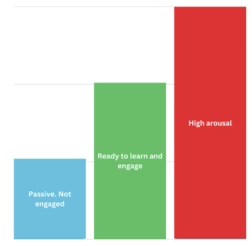
Sensory regulation is impacted by sensory modulation.
Some autistic students might be hypersensitive to particular sensory input in the environment or in their body and others might be hyposensitive. Some students have a mixed profile, where they are hypersensitive to some input and hyposensitive to other input.
Generally, people who are hypersensitive are more likely to experience high arousal and those who are hyposensitive are more likely to experience the passive presentation.
Useful resources
References:
Pastor-Cerezuela G, Fernández-Andrés MI, Sanz-Cervera P, Marín-Suelves D. The impact of sensory processing on executive and cognitive functions in children with autism spectrum disorder in the school context. Res Dev Disabil. 2020 Jan;96:103540. doi: 10.1016/j.ridd.2019.103540. Epub 2019 Dec 18. PMID: 31862533.
Read previous: ← Calm spaces
Read next: School uniform policy →